https://news.theregistrysf.com/san-franciscos-comeback-investors-why-were-betting-big-despite-the-ris
Exclusive developer roundtable reveals acquisition strategies, cost challenges, and fears that could derail the city’s recovery
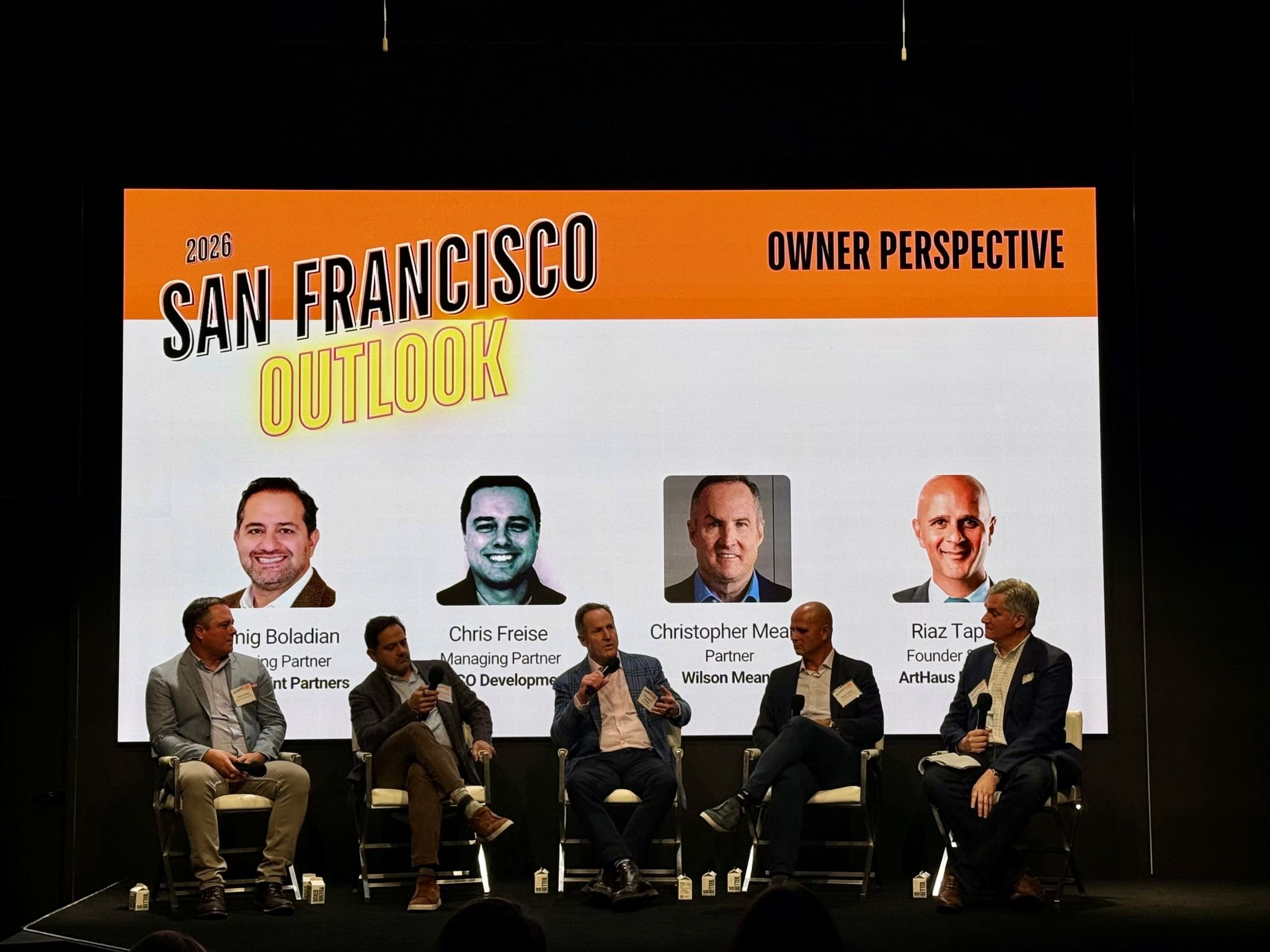
The developers and investors actually writing checks on San Francisco real estate delivered a blunt assessment at The Registry’s annual Outlook event last week: the recovery is real, fragile, and threatened by forces both local and global that could derail momentum at any moment.
Four principals managing billions of dollars in Bay Area real estate investments gathered for a candid discussion that ranged from janitorial contract markups to geopolitical uncertainties—revealing both the practical challenges of urban development and the existential risks facing the market.
Early Movers Capitalize on Distress
The panel brought together developers who have been among the most aggressive acquirers during San Francisco’s distressed period: Razmig Boladian of Rubicon Point Partners, Chris Freise of REDCO Development, Christopher Meany of Wilson Meany, and Riaz Taplin of ArtHaus Partners.
Their collective portfolio spans office conversions, multifamily repositioning, and master-planned communities like Treasure Island. What united them was a willingness to deploy capital when institutional investors remained on the sidelines—and growing concern about whether that bet will pay off.
“This has been a miserable six years that we’ve been living through in San Francisco, and so much of it is things we did to ourselves,” Meany said, praising Mayor Daniel Lurie’s administration for changing global perceptions but warning against complacency. “This will be a very fragile recovery if we don’t continue to dig in and dig hard and make ourselves better over the coming years.”
The Capital Markets Shift
Taplin, whose firm ArtHaus Partners focuses on workforce and attainable housing throughout the Bay Area, described the dramatic shift in investor sentiment over the past year.
For years, the pitch was nearly impossible. “Our problem was fundamentally, whether you say it was COVID or the Bay Area, we had dog shit performance,” Taplin said. “It’s a little hard to be there like ‘we’re doing really bad for you. You’ve been better off doing nothing. Please give us more money.’ It’s a difficult pitch.”
That changed in the second half of 2024. “For the first time, people were like, ‘Okay, there’s this dead cat bounce has occurred, and there’s a recovery. How do we play the recovery?'” Taplin said. He recently formed a $50 million strategic partnership with Belay Investments Group, signaling renewed capital availability.
“We are now seeing institutional money come in in a big way, whether it’s Madison Capital, Lone Star, like all these groups that are repeat buyers,” Freise added.
The Exit Capital Question
Despite transaction activity, a critical question remains unresolved: who will provide exit liquidity for value-add investors?
“We haven’t seen the second trade. We haven’t seen the core money coming in and buying the value add groups out of it,” Boladian said. “People that are spending $100-$150 million behind your building need to probably do a $300 million exit. That exit does not happen with another value-add fund.”
This uncertainty is shaping acquisition strategy. Boladian said Rubicon is focusing on cash-flowing office deals with strong credit tenants and smaller price points—assets that family offices can absorb if institutional buyers don’t materialize. The firm recently acquired a 50 percent vacant office building at 200 Pine Street in downtown San Francisco, betting on the Main Street corridor’s recovery.
Taplin noted his firm bought 300 units in Oakland for $100,000 per door—transactions that pencil to 10 percent cap rates. “At the end of the day, price is the best amenity for what I do,” he said. “My cost based on each of those units is $125,000 a pop. It’s a little hard to lose money when it would cost me $400,000 to replace it.”
The Construction Cost Crisis
Perhaps no topic generated more consensus—and frustration—than the Bay Area’s extraordinary construction costs, which developers identified as an existential threat to development.
Boladian described touring a Salt Lake City building where construction costs with tenant improvements ran approximately $400 per square foot. “That building is over $1,000 here,” he said. “Why? We both use similar materials.”
Union labor differentials have become particularly stark. Freise cited a 100,000-square-foot industrial project in Hayward where union bids came in at $160 per square foot versus $98 for non-union contractors. “This is not complicated construction,” he emphasized.
Meany questioned why union construction costs rose 65 percent over a period when general inflation was only 35 percent—and why those increases hit San Francisco harder than other markets. “Why does a union electrician in San Francisco work a seven-hour base pay day, and if you go outside of the city limits, it’s eight hours?” he asked. “That’s not anti-labor. It’s asking why are we treating San Francisco worse?”
All three developers stressed they build union and support organized labor, but argued the current cost structure makes projects financially infeasible.
Boladian offered another striking example of cost inflation. He described discovering a janitor making $24 per hour while his building was being charged $52 per hour. When he offered to pay $30 directly including overhead, “they’re like, ‘No, I’ll just go elsewhere.'”
A nearby building that’s 50 percent leased pays $1.2 million annually for janitorial services, he added, because “the capital sits in New York, that absentee capital outsourced to property management. When someone is willing to pay that money, that’s the new benchmark in the industry.”
Repositioning Strategies: Experience Over Expense
With costs high and lease terms shortening, developers are rethinking how to add value to office buildings.
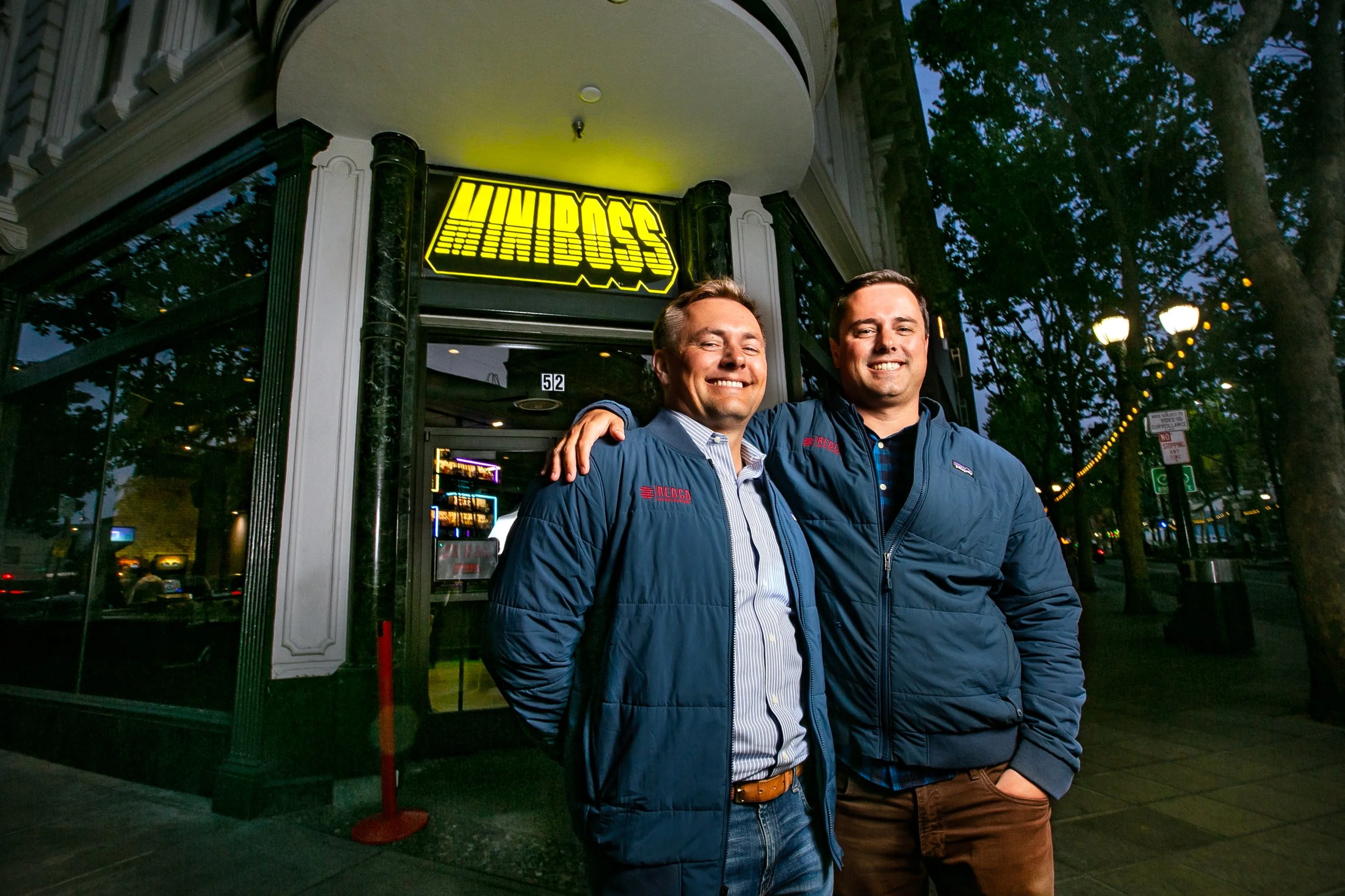
REDCO’s approach emphasizes experience and community over expensive finishes. “It is a highly personal, cultural community building exercise,” Freise said. The firm hosts quarterly happy hours, maintains ongoing tenant relationships beyond lease renewals, and is converting security staff into “hospitality service providers.”
At REDCO’s building at 10 California with construction partner GCI, the firm is installing “the most ambitious Andytown” coffee shop ever attempted, complete with DJ booth, pop-up bartenders, and a vinyl booth. The Wells Fargo building REDCO recently acquired will receive a $15 million lobby renovation and penthouse with four decks, targeting tenants seeking 200,000 square feet or more.
Cost efficiency extends to tenant improvements. Freise cited Roger Fields’ 550 California as a model—fully leased with average TI costs of just $35 per square foot. REDCO recently self-procured 80,000 LED lights for its 208 Utah building, saving $500,000.
“If you’re trying to do a $65 gross lease and your TI costs are $200-$250 a foot, you bought the building for $200 [per square foot], the math doesn’t work,” Freise explained.
AI: Savior and Threat
The artificial intelligence boom emerged as both the market’s greatest strength and potential vulnerability.
AI companies represent 25 percent of current San Francisco office demand. San Francisco-based AI companies captured 25 percent of worldwide venture capital funding in 2025.
“When you talk about a market that has a 35 percent vacancy and you say I’m optimistic that in the next couple of years I can be in the single digits, that doesn’t happen with organic growth,” Boladian said. “That happens with exponential growth that we’re seeing right now because of what AI is doing.”
But developers expressed anxiety about both valuation bubbles and longer-term displacement effects. Boladian described watching demonstrations of AI tools and their capabilities, noting conversations with tech CEO friends who say “there’s so many of our staff we don’t need anymore.”
“I think it’s going to completely change the way office is used, and as a result, the way retail, multifamily [are used],” Boladian said. “I think San Francisco is probably going to be the last to go. I’m not going to say we’re going to be immune from it, but that’s a big question mark.”
Taplin summarized the paradox jokingly: “The thing that’s going to save all of us is also going to kill all of us.”
Meany highlighted another troubling trend: AI tenants demanding shorter lease terms even as buildings require heavier capital investment. “The buildings are getting more expensive while the lease term is getting shorter. That’s what scares me,” he said.
Tax Policy: The Golden Goose Problem
Every panelist identified San Francisco’s tax structure as a competitive threat, though they differed on severity.
Freise reported that gross receipts tax is directly influencing location decisions for growing companies. “We’re seeing AI companies think, ‘Well, you know what, I’m gonna open a London and New York and an Irish and a Dublin office’ versus having 500,000 feet here. And you ask them why, and it is literally the gross receipts tax and how it impacts their business.”
Meany called for political engagement from the development community, including differentiating between taxes that must be opposed—like transfer taxes—and those that may be necessary, like transit funding measures.
“If we have a mayor that’s doing well, we have to tell them that, we have to support him,” Meany said. “We have to come out to the ballot and differentiate between things like the transfer tax, which has to be repealed, and things like community tax, which, frankly, we probably all have to swallow and support because we need public transportation.”
Market Bellwethers: Toast Sales and Young Professionals
Freise offered an unconventional metric for tracking recovery: Toast point-of-sale system receipts at the bar and restaurant his firm owns.
“This last year, we did $1.8 million, which for us was half a million dollars more than we thought we would have done,” he said. “When it’s a bar restaurant business, it’s really tough. So that’s a good sign.”
Multiple panelists cited the return of young professionals as evidence of sustainable momentum. Some firm’s tracks intern retention—young people who had been choosing New York and Austin are now staying in San Francisco.
The Geopolitical Wild Card
Taplin delivered perhaps the evening’s most sobering assessment when asked about threats to the recovery.
He described the post-World War II global economic order that allowed the Bay Area to thrive for 80 years—and the current administration’s willingness to destabilize it. The dollar’s status as reserve currency and U.S. Treasuries as the risk-free rate underpin American real estate markets.
“The idea that we have an administration that is playing with just those two things, forget everything else, is absolutely mind boggling,” he said. Could the 10-year Treasury yield spike to 10 percent with no buyers? “That could happen. That’s what scares me.”
Long-Term Optimism, Short-Term Fragility
Despite the litany of concerns, panelists maintained conviction in San Francisco’s fundamental advantages.
“This is the most beautiful city in the world. We have the most educated population in the world,” Meany said. “If we all commit ourselves to building our community, not just focusing on how we can cream a short term trend, we’re actually going to be fine.”
Taplin noted that “betting against the smartest people, the innovation capital of the world has been a mistake over and over again.”
The city’s challenge is navigating what developers believe is the early phase of a new boom without repeating past mistakes—overtaxing growth, allowing costs to spiral, and failing to build sufficient housing.
Boladian noted that rents in San Francisco have returned to pre-COVID levels, but “that money is worth 30 percent less, let us not forget, and the expenses are up by 30 percent.” True recovery requires rents rising another 20 percent just to reach 2019 purchasing power parity.
“We need three or four years of this in order to be back to an even place,” Boladian said.
Meany concluded with a challenge to the development community: take shared responsibility for the city’s trajectory. “A city in which it takes $410,000 of income to qualify for the median home is something we should not like, and we should go work on bringing down costs and making it so more people can live here.”